The fish arrived too late.
On Friday, April 24, 1671, the maître d’hôtel François Vatel receives his order of fish late. He decides to take his own life.
Born into a Swiss family, François Vatel came into the world as Fritz Karl Watel on January 17, 1631, in Tournai, in the Spanish Netherlands (present-day Belgium). The son of a farmer, he decides early on that he will not take over from his father at the head of the family farm.
As a teenager, he turns to the pastry cook and caterer Jehan Heverard, his brother’s godfather, to teach him the trade. Seven years later, in 1653, Vatel manages to be hired as a kitchen squire by Nicolas Fouquet, superintendent of finances to King Louis XIV, on the estate of Vaux-le-Vicomte, in Seine-et-Marne. Not only does Vatel learn the ropes quickly, he impresses his superiors enough to be appointed Fouquet’s maître d’hôtel.
On August 17, 1661, Fouquet throws a grand reception to inaugurate the château of Vaux-le-Vicomte, and invites Louis XIV, the queen mother Anne of Austria and the whole of the king’s court. François Vatel is put in charge of an immense dinner of eighty tables and thirty buffets, served on solid gold plate for the guests of honour and on silver for the rest of the court. Twenty-four violins play the music of Jean-Baptiste Lully, superintendent of the king’s music.
Molière stages Les Fâcheux (The Bores), a comédie-ballet in three acts, commissioned by Fouquet especially for the occasion. It is the first comédie-ballet in the world, and it marks the beginning of a collaboration between Molière and the choreographer and composer Pierre Beauchamps that will last twelve years.
In a text written for the Académie des beaux-arts, the chef Guy Savoy recalls the wonder of Jean de La Fontaine: “There was a magnificent supper, an excellent comedy, a most entertaining ballet, and fireworks that owed nothing to those set off for the entrance. All the senses were enchanted, and the feast had its beauties. […] The delicacy and rarity of the dishes were great. […] Never will Vaux be more beautiful than it was that evening.”
The opulence of the dinner does not have the hoped-for effect: Louis XIV takes offence at a display that wounds his pride, at a time when he himself is short of money. “Ah! Madam, shall we not make all these people disgorge?” he says to his mother on his return to Fontainebleau, according to the abbé de Choisy. Less than three weeks after the lavish dinner, the king has Fouquet arrested by d’Artagnan in Nantes, while Vatel flees to England for fear of being imprisoned in turn.
Across the Channel, he meets Jean Hérault de Gourville, a baron close to Fouquet, who introduces him to Louis II de Bourbon, Prince of Condé, and persuades him to hire Vatel at his château of Chantilly, some forty kilometres from Paris. There, in 1663, he becomes “comptroller general of the table”, and serves the famous crème Chantilly, whose invention is wrongly credited to him.
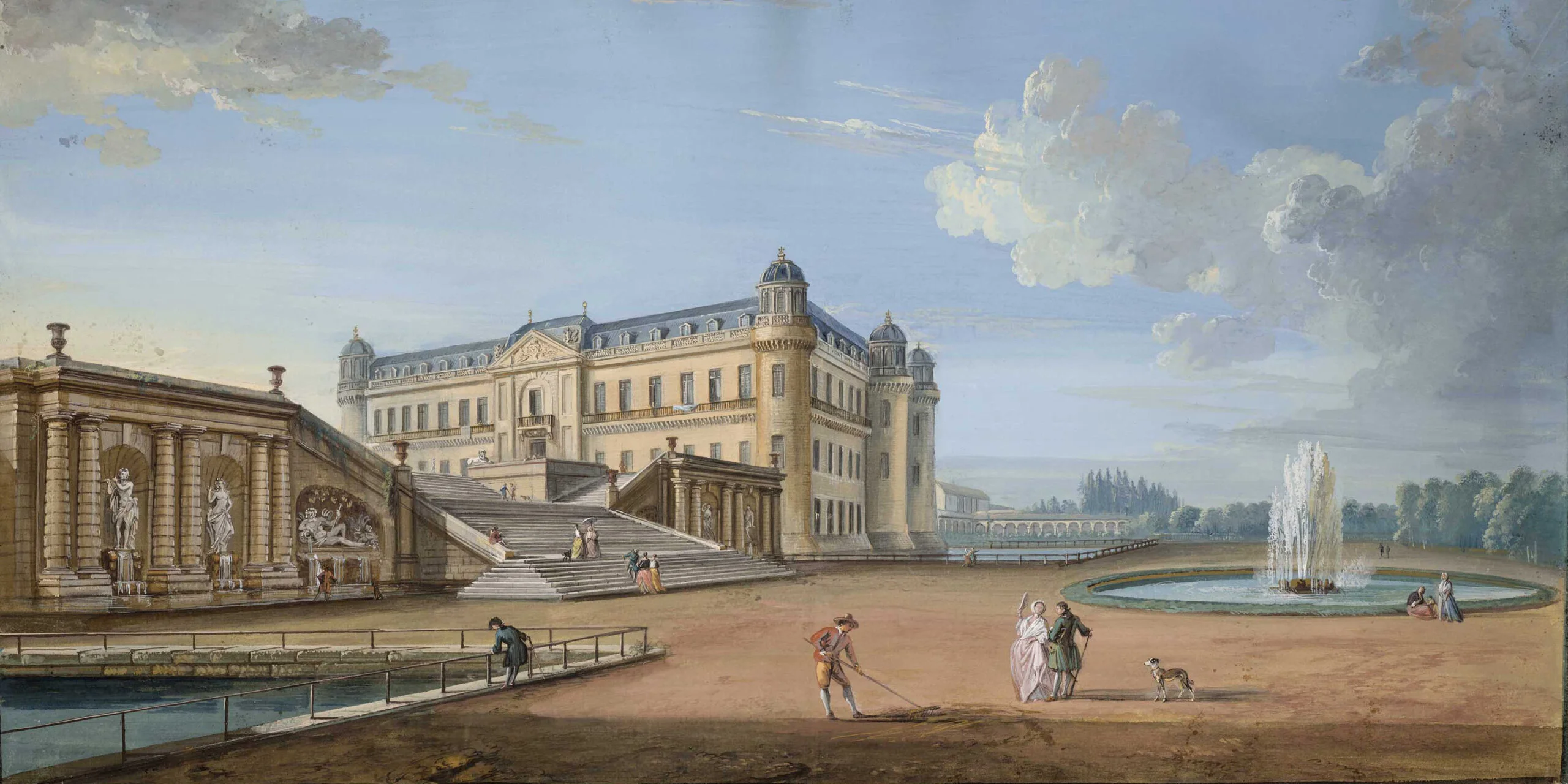
In disgrace since the late 1650s, and regarded as a traitor by Louis XIV for having fought alongside the king of Spain against the French army during the Franco-Spanish War, the Prince of Condé seeks to redeem himself by inviting the king, in April 1671, to a feast of reconciliation to mark the renovation of the château of Chantilly.
More than two thousand guests are expected for three days of extravagant festivities, from April 23 to 25, 1671, and their organisation is entrusted to a particularly anxious Vatel. The celebrations cost 50,000 écus (around 3 million euros today) and follow a principle Vatel held dear: “Harmony and contrast: all beauty proceeds from these two inseparable elements.”
But the architect of the event suffers one setback after another. On the first evening, a hundred or so unexpected guests leave two tables short of roast. The fireworks meant to close the evening are spoiled by a cloud. In a letter written to her daughter, Madame de Grignan, on Sunday, April 26, Madame de Sévigné reports that Vatel said again and again: “My honour is lost; this is an affront I shall not bear.” Then he confides to Gourville: “My head is spinning; I have not slept for twelve nights.”
The following night, at four in the morning, he despairs at seeing only a paltry part of the fish order arrive. Madame de Sévigné tells of this new disappointment further on in her letter: “He waits for some time; the other purveyors do not come; his head grew heated, he believes there will be no more fish; he finds Gourville and says to him: ‘Sir, I shall not survive this affront; I have honour and a reputation to lose.’ Gourville laughed at him.”
At the end of his tether, Vatel goes up to his room, wedges his sword against the door, and throws his body onto it three times, so that the point pierces his heart. A few moments later, fish arrives from every direction. The maître d’hôtel is quietly buried, and his death brings about the reconciliation of the Grand Condé and Louis XIV, who, it is said, go without fish in homage to Vatel.